An omnidirection camera with a fisheye lens has many advantages over ordinary cameras.
(1) All around view by one camera
→ no blind spot
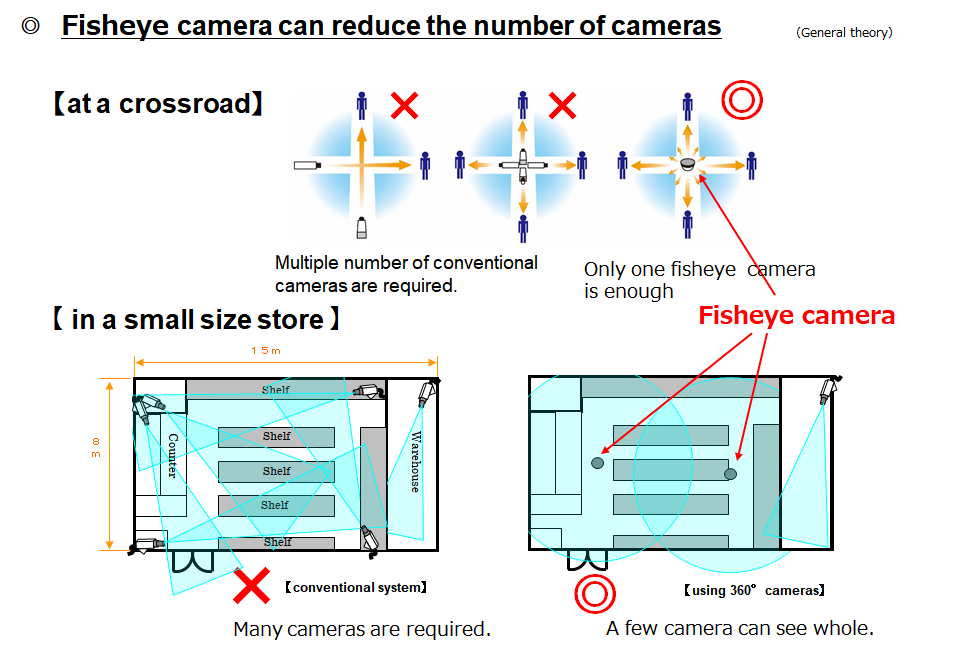
→ can reduce the number of cameras
→ can reduce the construction cost
→ can reduce the load of monitoring
→ easy to check the flow lines
(2) Because of the electronic PTZ
→ a long life with no moving mechanism
×
conventional camera with mechanical PTZ: 5,000 hours
◎
360° camera with fish-eye lens: 75,000 hours
(based on the MTBF)
(3) Excelent Cost Performance
→ because
of covering a wide range by one camera, possible to reduce the
number of cameras.
→ can reduce the construction cost
→ can reduce the number of monitors and load of surveillance
In other words, omnidirection cameras may be more profitable in places where multiple ordinary cameras are required.
A cheap directional camera is sufficient for the use at narrow and long places such as corridors and places where you want to monitor pinpointly. However, at the intersection of corridors, cameras are needed in each direction. If you use a fisheye camera, you can shoot in all directions by installing one at the intersection.When it comes to stores, an owner wants to see not only the inside of the store, but also the cashier's hands.
With a fisheye camera, it is possible to do that with just one camera.
Furthermore, fisheye cameras are convenient for tracking movement patterns due to their wide field of view.
In urban areas, when a crime occurs, footage from multiple privately installed cameras is stitched together to track the perpetrator.
A fisheye camera, with its wide field of view, makes tracking within the footage much easier.
It's also useful for managing the movement of workers and people in factories and shops.
By using fisheye cameras and regular cameras appropriately in different situations, you can reduce costs while minimizing areas that are not being monitored.
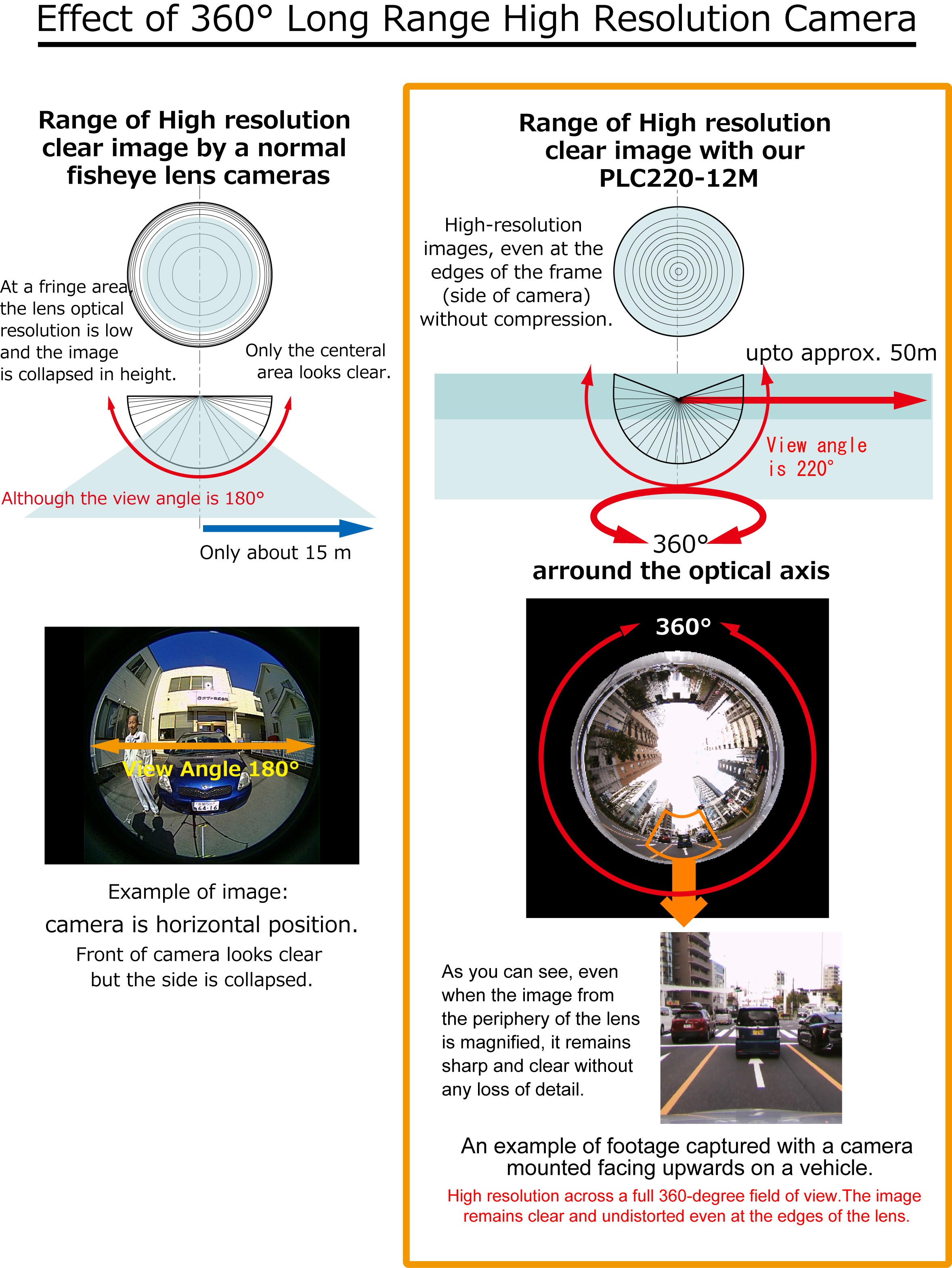
However, even such a convenient fisheye camera has its drawbacks. Images captured with a fisheye lens appear distorted because the image radiates outwards from the center of the lens. While software can correct this to some extent and make the image appear flatter, it's impossible to completely eliminate the distortion. This makes the image unsuitable for applications like facial recognition.Furthermore, with a typical fisheye lens, the image quality deteriorates as you move towards the edges of the lens, as the resolution decreases and the image height is compressed.
The image may look sharp in the center of the lens, but unfortunately, the outer edges are distorted.
Therefore, even though the field of view is a generous 180 degrees, the range where the image looks sharp is only about 130 degrees.
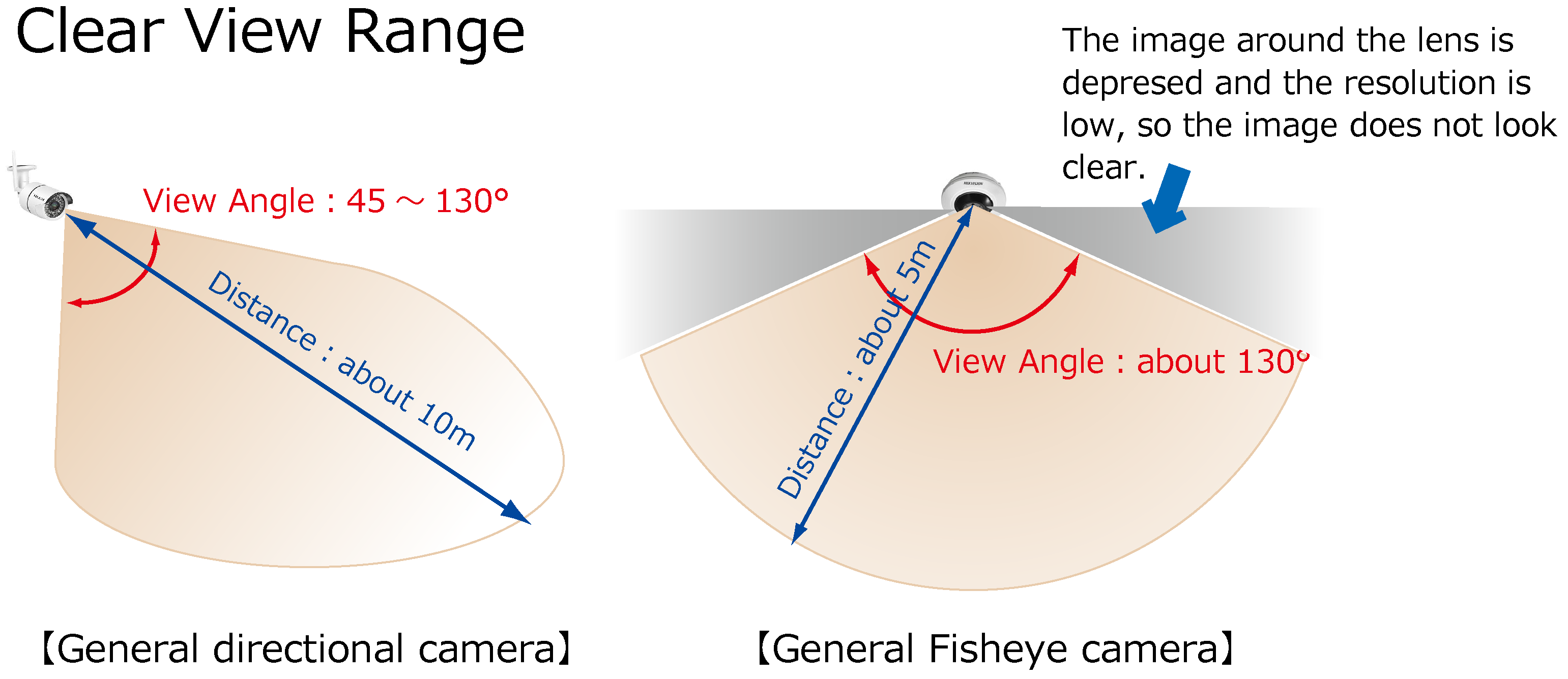
Our 360-degree camera captures a clear, 360° all aside of the camera, even at long distances.
Conventional fisheye lens cameras suffered from image distortion at the edges of the lens, resulting in extremely grainy images when electronically enlarged or flattened. Our newly developed fisheye lens achieves high resolution while maintaining a large image height at the edges. Furthermore, its downward angle allows for long-distance monitoring in a 360-degree range to the side of the camera.